Introduction
In July 1917, a report was laid before the British Parliament that stands among the most damning official inquiries ever produced into the conduct of a military campaign. The Report of the Commission Appointed by Act of Parliament to Enquire into the Operations of War in Mesopotamia, commonly known as the Mesopotamia Commission Report, was the product of months of testimony, thousands of pages of evidence, and the growing public outrage at a series of disasters in what is now Iraq. It did not mince words. It found failures of command, failures of government, failures of supply, and failures of medical care, a cascade of institutional breakdown that had cost tens of thousands of lives, and that had delivered to Britain one of the most humiliating military surrenders in its imperial history.
The report was not the product of a peaceful post-war reflection. It was written and published while the war was still being fought, a fact that made both its establishment and its conclusions deeply controversial. Careers were destroyed, a Cabinet minister resigned, and one senior general took his own life in its aftermath. Yet for the hundreds of British and Indian soldiers who died not from enemy fire but from want of basic medical care, or who perished as prisoners of war in conditions that shocked the conscience of those who later learned of them, the report came too late. Understanding what it found, why it matters, and what it ultimately failed to achieve is essential to understanding one of the most tragic and avoidable chapters of the First World War.
Origins of the Campaign and the Road to Disaster
The Mesopotamia campaign began in November 1914 when a British and Indian expeditionary force landed at Fao, near Basra, with the limited objective of protecting the Anglo-Persian Oil Company’s installations at Abadan and securing British influence in the Persian Gulf. The initial mandate was defensive and geographically modest. Basra was taken quickly, and the early progress of the 6th (Poona) Division of the Indian Army was impressive. The campaign’s commander at this stage, Major-General Charles Townshend, advanced up the Tigris with considerable tactical skill, winning a succession of engagements and pushing deep into Ottoman territory.
But from this early success came the seeds of catastrophe. What began as a limited expedition was gradually transformed, through a combination of political ambition, institutional overconfidence, and a catastrophic underestimation of the logistical and military challenges ahead, into a drive on Baghdad itself. This transformation was not the product of a single decision by a single man. It was, as the Commission would later find, the product of a systemic failure, of weak oversight from London, negligent administration from India, and reckless optimism from commanders in the field.
The Advance on Baghdad
By the autumn of 1915, General Sir John Nixon, commanding British forces in Mesopotamia, was pushing hard for an advance on Baghdad. The prize was political as much as military: a British capture of the ancient city would, it was argued, strike a powerful blow at Ottoman prestige and demonstrate British strength to wavering populations across the Muslim world. Nixon sent London and the Government of India in Calcutta a series of optimistic assessments of the military situation that consistently overstated his strength and understated the risks.
Townshend, for his part, expressed reservations about the advance but ultimately complied with his orders. His 6th Division, numbering some 14,000 men at the time of the decisive engagement, met the Ottoman forces under the command of Nur ud-Din Pasha at the Battle of Ctesiphon on 22 to 26 November 1915. What followed was a brutal reversal. The Ottoman forces, reinforced and fighting in prepared positions, inflicted heavy casualties. By the time Townshend ordered a withdrawal, he had lost nearly 4,600 men killed, wounded, or missing. His battered force fell back down the Tigris and took refuge in the small town of Kut-al-Amara, where it was surrounded by the Ottomans on 7 December 1915. The siege of Kut had begun.
The Siege of Kut and the Death of a Garrison
What followed over the next 147 days constitutes one of the most harrowing episodes of the entire First World War. Approximately 13,000 British and Indian troops, along with several thousand camp followers, were trapped inside Kut’s perimeter as the Ottoman forces steadily tightened their grip. Townshend had estimated his garrison could hold out for sixty days. When sixty days became a hundred, and the relief attempts repeatedly failed, the men inside Kut began to starve.
The winter conditions were brutal. Heavy rain filled the trenches with water, temperatures plunged below freezing at night, and the hospital roof leaked over the wounded. The garrison began slaughtering its horses and mules for food. Hindu and Muslim Indian soldiers refused horsemeat on religious grounds, and as malnutrition advanced they grew weaker and more susceptible to disease. During the five months of the siege, 1,025 men died from enemy action and 721 from disease; a further 2,500 were wounded and 1,450 were hospitalised. Those figures, shocking as they are, represent only the deaths of those still within Kut’s perimeter. The true toll of the disaster was far larger.
The Relief Failure and Its Casualties
Four major attempts were made to break through the Ottoman lines and relieve the garrison, all of them failures, and all of them conducted under conditions of medical and logistical inadequacy that the Commission would later identify as a central indictment of the entire campaign apparatus. A relief force under Lieutenant-General Sir Fenton Aylmer advanced in January 1916, attacking at Sheikh Saad on 6 January. Aylmer’s force was under pressure because of Townshend’s insistence that his garrison could only survive for sixty days, and this urgency led to attacks launched without adequate preparation, with insufficient artillery support, and with medical arrangements that were nothing less than criminally inadequate.
The scale of the medical failure was captured in a single, damning statistic identified by the National Army Museum: provision had been made at Sheikh Saad to handle 250 casualties. By 9 January 1916, there were 4,000 wounded in the Tigris Corps. Men lay in mud without dressings, without surgeons, without the most basic means of evacuation. Wounded soldiers waited ten days or more before they were assessed at field ambulances and sent to hospitals at Basra. The hospital ships that were meant to carry them downstream were inadequate in number, in equipment, and in staff. Many men died of wounds that, with prompt treatment, would have been survivable.
By the time all relief efforts had been exhausted, the attempt to save Kut had itself cost around 23,000 casualties, killed and wounded, including 10,000 in the final desperate weeks of April 1916 alone. On 29 April 1916, with food exhausted and all hope of relief gone, Townshend surrendered his garrison of 13,309 men to the Ottoman forces. It was the largest capitulation of a British force since the surrender at Yorktown in 1781. Historian Christopher Catherwood has called it the worst defeat of the Allies in the entirety of the First World War.
The Fate of the Prisoners
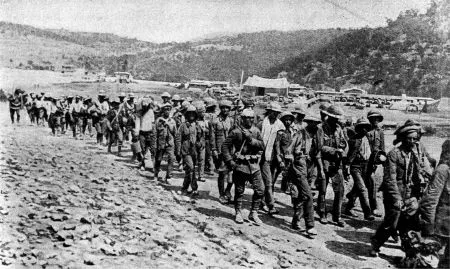
The suffering did not end with the surrender. The captured British and Indian troops were marched into captivity under conditions that shocked those who later investigated them. The march north through the Mesopotamian summer was conducted without adequate food, water, or medical attention. The treatment of the ordinary British and Indian soldiers at the hands of their Ottoman captors has been compared by historians to the treatment of Allied prisoners by Japan in the Second World War. Prisoners were used as forced labour to build railways through the mountains of Turkey. Of the approximately 13,000 men who surrendered at Kut, around 4,000 died as prisoners of war before the war ended in 1918, perishing from malnutrition, disease, and abuse. When the full scale of this suffering became known, it would add enormously to the public outrage that had already prompted the Commission’s establishment.
The Mesopotamia Commission: Establishment and Method
The political pressure that forced the government’s hand had been building for months before the formal surrender at Kut. Letters from soldiers in Mesopotamia, reaching relatives and eventually the press despite attempts by the military staff to censor officers’ correspondence, had already begun to paint a picture of disorganisation, mismanagement, and needless suffering. In Parliament, backbenchers pressed the government relentlessly for answers. Figures such as the 12th Earl of Wemyss seized on what they recognised as a scandal of major proportions, amplifying reports from the front and demanding a public reckoning. In August 1916, the Mesopotamia Commission was formally established by Act of Parliament. It was chaired by Lord George Cave, a former Cabinet minister, and included among its members a range of political, military, and administrative figures. Its task was to investigate the origins, conduct, and failures of the Mesopotamian campaign, with particular attention to the catastrophic events leading up to and following the surrender at Kut. The Commission held many sittings, took testimony from scores of witnesses including generals, politicians, civil servants, and medical officers, and accumulated a vast body of evidence. Its report was presented to Parliament in July 1917.
Key Findings: A Systematic Indictment
The Failure of Command in the Field: General Sir John Nixon
The Commission reserved its heaviest censure for the figure most directly responsible for the decision to advance on Baghdad: General Sir John Nixon, Commander of British forces in Mesopotamia from March 1915. The Commission found that the weightiest share of responsibility lay with Nixon, whose confident optimism was identified as the principal cause of the decision to push on toward Baghdad without the resources to do so safely. Nixon had consistently presented London and the Government of India with assessments of his strength and the enemy’s weakness that were, the Commission found, misleading. He had pressed for an advance that his supply lines, his medical services, and the size of his force could not sustain. When things went wrong, as they catastrophically did at Ctesiphon, Nixon’s optimism had already foreclosed the possibility of a timely retreat.
Nixon was further criticised for the state of the medical and transport arrangements under his command. The Commission found that these were not merely inadequate but shockingly so, and that Nixon had either failed to appreciate the scale of the deficiency or had chosen to minimise it in his reports. He was relieved of his command in January 1916 and replaced by General Sir Percy Lake, but the Commission’s findings ensured that his name became synonymous with the Mesopotamian disaster.
The Failure of Higher Command: General Sir Beauchamp Duff
Above Nixon in the chain of command sat General Sir Beauchamp Duff, the Commander-in-Chief of the Indian Army, based in Calcutta. Duff was responsible for overseeing the Mesopotamian campaign from India and for ensuring that it was adequately resourced and competently supervised. The Commission found that he had failed profoundly in both respects. Duff had supported an advance on Baghdad since 1914, despite the obvious lack of military resources to accomplish it safely. He had accepted Nixon’s optimistic reporting at face value and had failed to exercise the critical oversight that his position demanded.
The consequences of Duff’s failures did not end with the Commission’s publication. The public shaming delivered by the report, and the weight of responsibility attributed to him, contributed directly to his personal destruction. On 20 January 1918, General Sir Beauchamp Duff took his own life. His suicide stands as a grim testament to the human consequences of the Commission’s findings, and to the catastrophic toll that the Mesopotamian campaign took not only on those who fought it but on those who had commanded it from the comfort of Calcutta.
The Failure of Political Oversight: The India Office and Lord Hardinge
The Commission found that the responsibility for the campaign’s failures did not rest with military commanders alone. The Government of India, under Viceroy Lord Hardinge of Penshurst, was criticised for treating the Mesopotamian campaign as a peripheral matter and for exercising insufficient scrutiny over the military operations conducted under its authority. Hardinge’s administration had allowed the campaign to expand far beyond its original mandate without asking the hard questions about resources and risk that responsible governance demanded. When the crisis came, the Government of India was found to have been caught unprepared, having failed to build the logistical and medical infrastructure that a sustained campaign required.
At the political level in London, the Commission identified a fundamental failure in the relationship between the India Office and the field. The campaign had fallen into an institutional gap between the War Office in London and the Government of India in Calcutta, with each body assuming the other was exercising effective oversight. Neither was. The result was that the most consequential military campaign in India’s wartime experience was conducted without the strategic direction, resource allocation, or accountability that it required.
The Medical Catastrophe: The Vincent-Bingley Report
The Commission incorporated as Appendix I the findings of an earlier, smaller inquiry: the Vincent-Bingley Report, which had been convened specifically to examine the medical arrangements for the campaign. Its findings were devastating. It described a medical system that had collapsed under the weight of casualties it was never designed to handle, staffed by officers who lacked the resources to treat the men in their care, and supplied via riverboats that were inadequate in number and condition. Wounded men had lain in the mud for days waiting for treatment. Surgeons operated without sufficient instruments or dressings. Hospital ships had carried men who were already dying from wounds that should have been treated hours earlier.
The systemic character of this failure was emphasised by both the Vincent-Bingley inquiry and the Commission itself. This was not a matter of individual negligence but of institutional failure at every level: the failure of the Government of India to build adequate medical services before the campaign began; the failure of Nixon’s headquarters to anticipate casualties on the scale that modern warfare produced; and the failure of the War Office to impose minimum standards of medical provision on a campaign it had allowed to proceed without adequate scrutiny.
The Question of Townshend
The Commission’s treatment of Major-General Charles Townshend was considerably more nuanced than its handling of Nixon and Duff, and was widely criticised for being so. The Commission largely praised Townshend for his military skill and credited his early successes in the campaign. It accepted his argument that he had warned Nixon about the inadequacy of his force for the advance on Baghdad and that the ultimate decision to press on had been made over his expressed reservations. On this reading, Townshend was a capable commander who had been sacrificed by the failures of those above him.
This interpretation was contested at the time and has remained controversial ever since. Critics noted that Townshend had ultimately pressed forward to Ctesiphon knowing his supply lines were dangerously thin, and that personal ambition had played some part in his willingness to attempt what prudence should have refused. During the siege itself, accounts from within Kut described Townshend as increasingly withdrawn and mentally affected by the ordeal, leaving subordinates to manage day-to-day operations while he retreated into isolation. During the last weeks of the siege, as his men were starving, he sent telegrams to London requesting a promotion, a detail that struck many contemporaries and later historians as an extraordinary misjudgement of his situation and responsibilities.
What ultimately destroyed Townshend’s reputation was not the Commission’s findings but his conduct after the surrender. While his men were force-marched into captivity and put to work building Ottoman railways in conditions of brutal hardship, Townshend was taken to an island near Constantinople where he lived in considerable comfort, growing close to his captors and, by some accounts, cooperating with them in ways that many of his countrymen found difficult to forgive. When he returned to Britain in October 1918, he was initially celebrated as the Hero of Kut, and in 1920 he was elected to Parliament. But as the true conditions endured by his men in Turkish captivity became publicly known, and as the contrast with his own comfortable imprisonment became impossible to ignore, his reputation collapsed. He remains one of the most contested figures of the First World War: a talented tactician, badly served by his superiors, whose personal behaviour in captivity betrayed the men whose welfare remained his responsibility.
Political Consequences and the Limits of Accountability
The Resignation of Austen Chamberlain
The most immediate political consequence of the Commission’s report was the resignation of Austen Chamberlain, the Secretary of State for India. Chamberlain accepted personal responsibility for the failures of oversight on the part of his department, acknowledging that the India Office had not exercised adequate supervision over a campaign conducted under its nominal authority. His resignation was one of the few ministerial resignations of the entire war that could be directly attributed to the findings of a parliamentary inquiry. It was widely seen as a mark of personal honour in circumstances that might have prompted others to bluster and deflect.
The Commission had been careful to note that it was not recommending courts-martial and that its findings could not be used as the basis for criminal proceedings, a limitation that drew considerable public criticism. Legal counsel advising the government noted that the statutory rules governing military inquiries required any officer whose character or military reputation was affected to be present and to have the opportunity to cross-examine witnesses, a procedure that the Commission, operating under different terms, had not followed. The result was that no commander was tried, no general was court-martialled, and the formal apparatus of military justice was never brought to bear on those the Commission had found most responsible.
A Verdict Without Consequences
This gap between finding and punishment became the most enduring criticism of the Commission and its report. The public and the press had expected accountability in a form that the legal constraints of the system could not deliver. The Commission had named names, apportioned blame, and delivered a verdict of collective institutional failure. But the mechanisms for acting on that verdict were absent or obstructed. Military law could not be applied retroactively on the basis of Commission evidence. Political will to push harder was limited by the ongoing demands of a war that was still very much in progress. The men most responsible for the disaster were retired, shamed, and in the case of Beauchamp Duff, broken, but they were not prosecuted.
Legacy: The Human Cost and Its Meaning
The final accounting of the Mesopotamian campaign makes for sombre reading. Total Allied casualties for the campaign as a whole reached approximately 92,500, of which around 15,000 were killed in action, 13,000 died of disease, 51,000 were wounded, and 13,000 were taken prisoner or went missing. Of those taken prisoner at Kut, nearly 4,000 died in captivity before the war ended. These are the numbers that give the Commission’s findings their moral weight: behind every finding of institutional failure, every criticism of inadequate supply, every censure of reckless command, lay a specific, preventable death.
The Commission’s report did prompt significant changes. The War Office assumed administrative responsibility for the Mesopotamian campaign, removing it from the India Office’s oversight, and a thoroughgoing reorganisation of command, supply, and medical services was undertaken. The new commander, General Sir Stanley Maude, was given the resources and the time to rebuild the force properly. In March 1917, just eight months after the Commission’s report was published, Maude’s reformed army captured Baghdad, the prize that Nixon had sought to seize with an understrength, undersupplied force and whose pursuit had produced the catastrophe the Commission had been established to investigate.
The Commission’s report has attracted renewed scholarly interest in recent decades, particularly in the context of the Chilcot Inquiry into the 2003 Iraq War. The parallels are uncomfortable: the same theatre of operations, the same disconnect between political ambition and military reality, the same institutional failures of intelligence, planning, and command accountability. Scholars examining the 1917 report have noted, as Nadia Atia and others have argued, that the Commission’s published findings represented only a partial version of the evidence it had gathered, that conspicuous absences in the final document reflected political calculations about what a wartime public and Parliament could be shown.
What endures from the Mesopotamia Commission is the portrait it drew of how democracies go to war badly: how political ambition outruns military capacity, how institutional fragmentation produces unaccountable failure, how the men at the bottom of the chain of command pay in blood for the decisions made at its top, and how the formal mechanisms of accountability, inquiries, resignations, reports to Parliament, can name failure without truly reckoning with it. The soldiers who died in the mud at Sheikh Saad, or who perished of thirst on the march to Aleppo, were not killed by the Ottoman Empire alone. They were killed by the indifference of the Government of India, the overconfidence of John Nixon, the institutional paralysis of the India Office, and the accumulated weight of a military and political culture that placed prestige above lives. The Commission said as much. Whether anyone in power truly listened is another question.
Why This Report Stood Apart from the Rest of the War
The Mesopotamia Commission Report of 1917 occupies a singular place in the history of the First World War. No other episode of that conflict produced an equivalent document, a parliamentary report, published while the war was actively being fought, that named serving and recently serving generals and officials by name, apportioned blame with forensic specificity, forced a Cabinet minister from office, and was acknowledged even by the government itself as a devastating indictment of the institutions responsible for the campaign. It was not a quiet internal review; it was a public reckoning conducted under parliamentary authority and delivered to the nation in the middle of the bloodiest conflict in recorded history.
A Wartime Inquiry Without Precedent
The very act of establishing the Commission was remarkable. Britain in 1916 was fighting a war of national survival. Hundreds of thousands of men had died on the Somme barely weeks before the Commission’s first sittings. The government was under enormous pressure to maintain morale, suppress dissent, and project an image of unified, competent leadership. In that context, the decision to appoint a parliamentary commission to investigate military failures in real time, to scrutinise the decisions of serving generals and sitting ministers while the war continued, represented a genuinely unusual exercise of democratic accountability. As was observed in the Hansard debates of July 1917, any government undertaking such an inquiry during active operations was taking a significant political risk.
No comparable inquiry was conducted into the Western Front. The catastrophe of the Somme, where nearly 60,000 British soldiers were killed or wounded on the first day alone, produced no equivalent parliamentary commission during the war. The failures at Gallipoli were investigated, but the Dardanelles Commission’s report was not published until 1919, after the armistice. The Mesopotamia Commission was unique in delivering its verdict while fighting continued, and in doing so it established a precedent, contested and uncomfortable, that democratic governments could and should hold their military and political establishments to account even in wartime.
The India Problem: A War Fought from the Wrong Address
A second quality that set the Mesopotamia campaign and its inquiry apart was the campaign’s peculiar constitutional position. Unlike any other major theatre of the First World War, Mesopotamia was initially an Indian Army campaign, run not from the War Office in London but from Calcutta and Simla. The 700,000 Indian troops who ultimately served in Mesopotamia represented the largest Indian contribution to any single theatre of the war. Yet the governance of that campaign was divided between two authorities, the India Office in London and the Government of India, in ways that the Commission found had produced a vacuum of accountability at the highest level.
This arrangement had profound implications for public awareness. The Mesopotamia campaign was, to a remarkable degree, fought by soldiers who were not British in the conventional sense understood by the British public: they were Indian Army sepoys, drawn from across the subcontinent, whose stories did not easily reach the British press. The letters home from Indian soldiers were written in Urdu, Punjabi, Bengali, and a dozen other languages. Their deaths were mourned in villages across the Punjab and the United Provinces, not in the Lancashire mill towns or the Scottish farming communities whose losses dominated the British domestic narrative of the war. The Commission’s finding that the campaign had been managed from India as though it were a peripheral affair of the Raj, rather than a major theatre of the Empire’s war, reflected a deeper truth about whose sacrifice was being made and how little it was seen.
The Censorship of Soldiers’ Letters
That relative invisibility was not entirely accidental. The Commission found, and it was widely reported at the time, that the military staff in Mesopotamia had made efforts to censor officers’ letters home, suppressing accounts of the conditions that were filtering back to relatives and, through them, to the press. The attempt to manage the information environment around the campaign was a signal that those running it knew the reality was indefensible. When those letters began to break through, when accounts of wounded men lying untreated in the mud, of catastrophically under-supplied hospital ships, of men dying of preventable disease at a rate that had no parallel in other theatres, the effect on public and political opinion was immediate and intense. The Commission had been established precisely because those accounts could no longer be contained.
This censorship attempt stands in sharp contrast to the Western Front, where the scale of loss was so vast, so universally distributed across British society, and so evidently impossible to conceal that no equivalent effort was made. Mesopotamia was different: it was distant, it was fought largely by Indian troops, and its commanders believed for longer than they should have that its failures could be managed quietly. The Commission’s report shattered that hope permanently.
Impact on Public Opinion and Awareness
The Report as a Political Shock
When the Commission’s report was published in July 1917, the reaction in the British press was immediate and forceful. The Times had already been running editorials critical of the Baghdad advance as early as May 1916, demanding to know who had authorised the push that resulted in the Kut catastrophe. The publication of the report gave newspapers, parliamentarians, and the public a detailed, authoritative, and officially sanctioned account of failures that many had suspected but could not previously document. It was, as one contemporary medical journal noted, decidedly not of the whitewashing order, it cultivated within its limits both thoroughness and frankness, and neither methods nor men escaped scrutiny.
The resignation of Austen Chamberlain amplified the report’s impact considerably. Cabinet resignations in wartime are rare events, and Chamberlain’s willingness to accept personal responsibility, however partial, confirmed to the public that the failures documented in the report were real, serious, and attributable to identifiable individuals at the highest levels of government. The fact that Lord Hardinge, though equally censured by the Commission, did not resign, and indeed continued in his post as Permanent Under-Secretary of State at the Foreign Office, generated considerable political controversy and kept the report in the parliamentary discourse for weeks. Questions were asked in the House about the differential treatment of military officers, who had at least been removed from their commands, and of civilians who remained in post despite equivalent or greater censure.
The Somme Effect: How Mesopotamia Was Eclipsed
Yet despite the initial shock of the report’s publication, and despite the genuine political consequences it produced, the Mesopotamia campaign struggled to secure a lasting place in the public consciousness of the war. The central reason was geography and timing: the Somme. The catastrophic opening of the Battle of the Somme on 1 July 1916, barely two months after the fall of Kut, absorbed the overwhelming majority of British public attention, press coverage, and political energy for the remainder of that year and well into 1917. The scale of loss on the Western Front was simply so vast, and so universal in its reach across British communities, that no other theatre could compete for sustained attention. The fall of Kut, which on any other measure might have dominated public discourse for months, was rapidly overshadowed by a battle in which 57,470 British soldiers became casualties in a single day.
This eclipse had long-lasting consequences for how the Mesopotamia campaign was remembered. Ex-servicemen who had fought in Mesopotamia returned to Britain after the war to find their campaign described as a sideshow, a term that many found deeply offensive given the scale of the sacrifice involved. They wrote memoirs, gave lectures, and lobbied for recognition, partly out of injured pride and partly because they recognised that the political lessons of the campaign, the lessons the Commission had tried to codify, were in danger of being forgotten along with the campaign itself. As one writer on the subject has recorded, politicians campaigning in the 1922 general election felt free to say publicly of Mesopotamia, in the words of Bonar Law, that they wished they had never gone there, a remark that would have been unthinkable in relation to the Western Front.
The Indian Dimension: A Differently Heard Report
If the report had a relatively muted long-term impact in Britain, its reception in India was considerably more complex and politically charged. The Commission had censured the Government of India and the Viceroy, Lord Hardinge, in terms that raised uncomfortable questions about the governance of the Indian Army and the relationship between Indian troops and the British command structures that directed them. Roughly 50 percent of the Indian soldiers captured at Kut died in Ottoman captivity, a statistic that, when it became fully known, generated profound anger among Indian political communities and served as a further indictment of the campaign’s management.
The Commission’s report thus entered the Indian political conversation at a moment when questions about Indian self-governance and the rights of Indian soldiers were becoming increasingly difficult to suppress. The Indian press, particularly in the Punjab from which so many of the Mesopotamia soldiers had been drawn, was attentive to the Commission’s findings even where British newspapers had moved on. The image of Indian soldiers dying in the desert in conditions that Parliament itself had condemned as the product of negligence and indifference was not easily reconciled with the imperial narrative of a benevolent and competent British administration. It contributed, in ways difficult to quantify precisely but impossible to dismiss, to the erosion of confidence in British imperial governance that would accelerate dramatically after the war.
The Long Shadow: From Chilcot to the Present
The most striking evidence of the Mesopotamia Commission’s distinctive standing in the history of wartime accountability is the frequency with which it has been cited by scholars and commentators examining later British military adventures in the same territory. When the Chilcot Inquiry was established in 2009 to examine Britain’s participation in the 2003 Iraq War, academic specialists immediately drew attention to the parallels with the 1917 Commission: the same geography, the same disconnect between political ambition and military preparation, the same questions about the quality of intelligence and the adequacy of post-conflict planning, and the same institutional reluctance to accept systemic responsibility. The RUSI Journal published an explicit comparison under the title Britain’s First Iraq Inquiry, and the scholarly parallels were noted across the historical and political science literature.
Those parallels are not merely superficial. Both inquiries were the product of public pressure that overcame governmental reluctance to submit military and political decisions to independent scrutiny. Both produced reports that named individuals and attributed blame in terms that went well beyond what the formal mechanisms of accountability could act upon. Both were criticised, from different directions, for being simultaneously too damning in their findings and too limited in their consequences. And both were conducted in the shadow of a public that had been told, at the outset of the relevant campaign, that the venture was manageable, necessary, and likely to be concluded quickly.
What the Mesopotamia Commission achieved, for all its limitations, was to establish that parliamentary democracy retained the right and the capacity to examine military failure even in the most adverse political circumstances, and to place on public record, in specific and documented detail, the human cost of allowing political ambition, institutional inertia, and unaccountable command to override the most basic obligations of a state to the men it sends to war. That achievement was imperfect, partial, and in some respects deliberately constrained. But in a war characterised above all else by the willingness of governments and general staffs to continue sending men to their deaths in the name of objectives that were never clearly defined and never honestly assessed, it represented something genuinely unusual: a moment of democratic reckoning, conducted while the killing was still going on.
Based on the Report of the Mesopotamia Commission (Cd. 8610), published July 1917.
Read the full Report
The complete digitised text of the 1917 Report is freely available online:
archive.org/details/mesopotamia-comm-report1917