Evidence of Inaction
The CWGC formally withdrew from Iraq in 1990, the year Saddam invaded Kuwait. However, there is evidence of disengagement before this, with the few publicly available images after the 1950's when all these sites appeared in good condition showing the sites in increasing levels of disrepair.
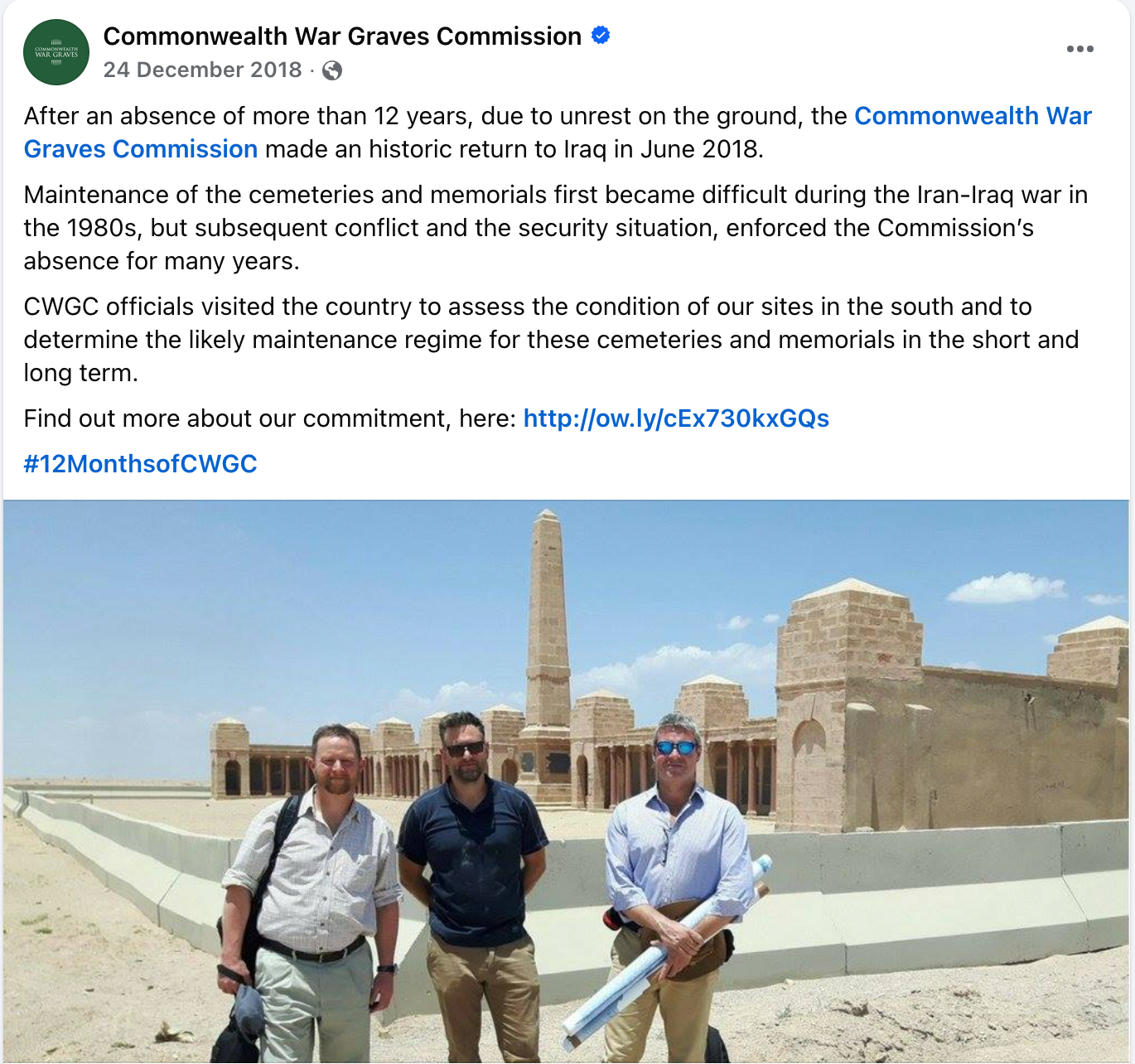
The last public visit by CWGC staff was in 2018 when a "historic return to Iraq" was announced. This involved a small team from CWGC visiting Basra for a few days. This historic return was short lived and there has not been a single visit since, despite thousands of international organizations visiting and working in Iraq from all over the world including major industries, archaeology and development.
Timeline of CWGC Activity in Iraq
Since 1990 only a small number of projects have taken place. These have been managed remotely by CWGC staff using both local contractors and international companies to conduct the work.
| Year | Site | Activity |
|---|---|---|
| 1998 | Amara British Cemetery | Demolition of Amara gatehouse |
| 2012 | Baghdad Northgate | Replacing 511 gravestones |
| 2012-14 | Kut | Renovation |
| 2018 | Basra | Fence erected at Basra Cemetery, cement bollards surrounding Basra Memorial |
| 2019 | Habbaniya | Renovation |
| 2021 | Ma'Asker RAF Cemetery | Boundary wall constructed |
| 2012 | Mosul | Complete clearance of site up to 2 feet below grade. Storage hut on graves. |
The clearance work at Mosul War Cemetery is documented in detail, with photographs from the October 2025 field visit showing the excavation of the site, the removal of every grave marker and sub base, and the storage hut erected over the Second World War graves in Plot 1.
Lack of Oversight and Accountability
The lack of knowledge and experience of Iraq within the CWGC is a major impediment to effective action.
The work that has been done in the last 35 years is, with the exception of Habbaniya, of poor quality and incomplete and without adequate follow up maintenance.
Some of the network of custodians and guardians are dedicated but lack the resources and support to undertake their role. It should also be noted several of the guardians and custodians of the sites say they have not been paid for past work, or at all.
Others working on behalf of the CWGC are less impressive. Contractors lack the experience and skills to work with sites of this sensitivity and age. They lack training, oversight and clear direction. The system of self-reporting is open to abuse and lacks accountability. Undirected and inappropriate work and employees who are not held to account for their actions wastes valuable resources and calls into question the lack of oversight of funds given, in good faith, to support the work of the Commonwealth War Graves Commission across the world.
Excuses for Inaction
In the 30 years my family has been enquiring with the CWGC about my grandfather's grave and Basra War Cemetery as well as other sites in Iraq, the feedback has been remarkably consistent regarding their reasons for inaction:
- Security
- Funding
- Inability to secure insurance
- Risk of sites being damaged
Security
The US State Department's Country Reports on Terrorism, UNAMI, Iraq Body Count show very few (2 in fact) isolated incidents of deliberate attacks on foreigners since the fall of ISIS at Mosul in 2018.
The recent elections in November passed without incident. European airlines have started flying into Baghdad and tourism is increasing.
Hundreds of thousands of foreigners are working in Iraq and thousands of international organisations including those from the US and Europe. There is no rational reason why the CWGC is incapable of working effectively in Iraq.
'This is where civilisation started - and the locals are very polite': For adventurous tourists who are unafraid of the occasional military roadblock, the hot new destination is IRAQ
- ›After years of bloody conflict, Iraq is enjoying a 'mini-boom' in tourism
- ›Most Western governments still issue travel warnings for all or parts of Iraq
- ›Last year, Iraq attracted 107k tourists including from Britain, France and the U.S
EXCLUSIVEI'm a British female solo traveller and just got back from a holiday in Iraq - here's why it was amazing
- •A British woman who solo travelled Iraq has revealed what her trip was like
- •She stayed with a host family and couch surfed with a complete stranger
From ancient Babylon to the marshes of Mesopotamia: Why Iraq is becoming the world's most unexpected tourist hotspot
- •Tour operators report surge in bookings for Iraqi heritage sites
- •Baghdad's historic districts now welcoming international visitors
Funding
As previously noted, with Iraq accounting for 3% of all Commonwealth casualties globally and an annual GBP20m budget, a minimum of GBP2.4m should be spent on Iraq every year. This would be much more if the treatment of Indian Forces casualties were to be rectified under the Non-Commemoration project. Over the 25 years since CWGC has been absent this would be the equivalent of GBP60m that should have been spent but less than 1% of it has been.
The Commissioners and Executive leadership of the CWGC are not short of funds; they have chosen to prioritise other projects—the largest being in France with a new cemetery, the Loos British Cemetery Extension (1,200 capacity), complete renovation of Menin Gate and a Visitor Center and gift shop, just in the last 2-3 years. The choice was made to prioritise a visitor center over the proper commemoration of war casualties, a direct violation of their own mission.
Whilst expecting the decades of lack of funding to be made up quickly it is entirely reasonable that the GBP2.4m is spent annually—this goes a very long way in Iraq.
FCO Travel Guidance and Insurance
The FCO travel guidance for Iraq has been relatively constant with a two tier system:
- Some areas: "advise against all travel"
- Other areas: "advise against all but essential travel"
The CWGC is not a part of HM Government but an inter-governmental agency. It is not required to adhere to any FCO guidance.
It may have a policy not to do so but this is not applied uniformly. As an example, Israel has had the same travel guidance as Iraq as recently as Dec 2024. This has not prevented CWGC maintaining an office and staff there despite the country being in almost constant state of war with surrounding countries and global humanitarian bodies including the United Nations Human Rights Council, the International Criminal Court and Amnesty International / Human Rights Watch accusing the government of war crimes with estimates of up to 170,000 casualties from recent years with a high proportion of civilians.
An inability to secure insurance given the FCO travel advice level in Iraq has been communicated by both CWGC and the MOD in response to questions on absence in Iraq. FCO travel advisory for Iraq invalidates almost any standard personal or corporate insurance. However, specialist insurance for Iraq is readily available for both personal and corporate travel.
If the CWGC is claiming that they can't travel to Iraq due to their current insurance policy excluding it, that might technically be true. However, the statement that it cannot get insurance is patently untrue and their insurance broker could secure it readily.
Risk of Sites Being Damaged
It has been suggested by sources that know them and Iraq well that the CWGC will not conduct any proactive renovation of sites in Iraq until the threat of vandalism has reduced. It's not clear what criteria this might use.
In comparison, the War Memorials Trust which monitors cases of vandalism, theft and anti-social behaviour against UK war memorials reported in 2023-24 there were 32 incidents of theft, vandalism and anti-social behaviour that they were aware of. The real number is likely orders of magnitude above this. So vandalism is something that is universal, not limited to Iraq.
If the suggestion is that there is an inherent risk in Iraq due to cultural or religious animosity to the UK and Commonwealth countries and non-Muslims this can easily be rejected with data and reflects more on the CWGC and potential implicit organisational bias rather than Iraqis:
- The majority of the casualties are not Christian but Hindu, Muslim and Sikh
- There are Christian churches in Basra (the Chaldean Archbishop of Basra attended the recent Remembrance service along with a Muslim cleric), Baghdad, Mosul and many other cities
- There are many Christian cemeteries in Iraq including adjacent to the Indian Forces cemetery in Basra, the British Cemetery in Baghdad and the Armenian Christian cemetery in Mosul—all featuring Christian symbolism and having existed for over 100 years
- There is a Jewish grave marker in Kut War Cemetery, completely untouched and in perfect condition
- There is no animosity to the US or UK or its citizens—quite the opposite. The most frequent question I received was how to study in the UK
NEWS
8 years after ISIS, two historic churches in Mosul reopen their doors
In the heart of Mosul's Old City, politicians, clergymen and members of the faithful gather to reinaugurate the Mar Toma and Al-Tahira churches, which had been vandalised and destroyed by so-called Islamic State.
The Commonwealth sites have been abandoned for decades, a clear signal that the UK and Commonwealth countries don't care what happens to them. Why should we therefore be surprised if others treat them poorly. It's nothing compared to the damage the CWGC has done through inaction and the use of ill judged contractors poorly supervised.
Where damage has occurred in Basra for example where gates were removed from the gatehouses, this was done as a direct retaliation against the heavy handed approach by the CWGC contractor seeking to prevent the use of the land for recreational sport.
These sites are terrible blights on their neighbourhoods. There is nothing the local communities would like more than for these to become an asset to their areas, creating jobs and investment.
Vandalism will certainly occur but if the communities are engaged this will help ensure the long term protection and care of these sites.